/ HOW IT WORKS /
How the floor works.
Contracts, flows, and data sources used by the app. Half of every purchase goes to holders, half becomes floor.
Process
01
People trade $FLR
FLOOR launches on Pons v2: it opens on a bonding curve holding the whole
supply, and a permanently locked Uniswap v4 pool is created at graduation.
Nothing migrates, nothing unlocks.
Pons v2
02
2% of every trade buys stocks
On top of the standard Pons fee, $FLR charges a 2% creator tax that goes
entirely to the treasury — on buys and on sells, always in ETH,
never in $FLR itself. It is not a fee that disappears into a wallet: it buys
NVIDIA, Apple, Google, Tesla, gold, the S&P 500 and Strategy (a Bitcoin proxy), and half of it comes back to you.
2%
03
The treasury buys the basket
Collected WETH is split across the basket. Each line is
swapped on the venue where its market actually is — six of the seven
route through USDG.
7 assets
04
Every purchase splits in two
Half of what the treasury buys is set aside for holders. The other half stays as floor and only leaves through a burn.
50 / 50
05
Holders claim, without burning
Your share of the set-aside arrives by claiming. You keep every token you own. The burn door stays open separately, as a floor.
On chain
Yes, 2% is a tax. We would rather you hear it from us. Most taxed
tokens cannot tell you where the money goes. This one can: every cent of it enters the
treasury, buys tokenised equities on-chain, and half of each purchase is set aside for
holders to claim. You can read the balance from the contract yourself — the app
does exactly that on the Overview page.
Traders pay 3% in total. Pons takes 1% on every launch it hosts,
and our 2% sits on top of it. That is the same total as The Index,
which charges a flat 3% on this chain for a comparable promise — we read their
hook to check rather than take their word for it.
So the difference is not the price. It is what happens to the money: theirs lands in
a treasury, ours buys equities, sets half of every purchase aside for you to claim, and
burns supply on the way.
Two doors, and they do different jobs
This is the part most people get backwards, so it is worth being blunt about it.
| Burn to redeem | Claim |
|---|
| You give up | Your tokens, destroyed. | Nothing. |
| You receive | Your pro-rata slice of the floor, less 5%. | Your share of the set-aside. |
| What it is for | A price that cannot reach zero. | Getting paid in equities. |
| When to use it | Only if the market price ever falls below the floor. | Every epoch. |
Burning is not how you make money. Buy $200 of FLR, burn it
immediately, and you get back whatever the floor is worth — a fraction of what you paid.
Nobody does that. You profit by selling higher, like any token.
Walk through it with real numbers
This is the question everyone asks, so here is the arithmetic instead of the theory.
Say a buyer named Mike puts $500 in at a $100k market cap. A day later the token is at
$70k, so his position is worth $350. Say the treasury has bought $10k of equities by then. That $10k spread
across the whole supply means the floor is worth about 14% of the market cap.
If Mike burns, he destroys his tokens and receives his pro-rata slice of that floor:
roughly $49, less the 5% exit fee, so about $46. Against $350 if he simply sells.
Burning would cost Mike 87% more than selling. He should never do it, and neither
should you. That is not a flaw in the design. It is the mechanism working exactly
as intended.
The burn door is not an exit. It is a magnet.
The floor is a hard number: equities held, divided by tokens in circulation. Say it works
out to $0.00014 per token.
Now suppose the market price ever fell below that, to $0.00010. Anyone could buy
tokens at $0.00010 and burn them for $0.00014 of real Nvidia and Apple shares. That is
free money, so bots would do it on repeat, buying tokens every time, which pushes the
price back up until the gap closes.
The price cannot stay below the floor. Not because anyone promises it, but because
it would be profitable for a stranger to fix.
The burn door exists to be available, not to be used. In Mike’s case
the price sits five times above the floor, so the door is irrelevant to him today. It would
only matter if the market cap collapsed to around $14k. That is the whole point: it is the
thing standing between him and zero.
So what actually helps Mike
Three things, and none of them is burning.
Claiming. Every epoch, if he holds at least 0.1% of supply, his share of
the equities arrives without burning anything and without losing a single token. He
keeps his full position and accumulates real Nvidia at the same time. This is his
mechanism. The burn door is not.
A price that cannot reach zero. At $70k he is far above the floor, so it
does nothing for him today. But it is what stops his position from becoming strictly
nothing, which is the usual ending for a memecoin.
The buyback. Half of every fee buys the token back and burns it. Supply
falls, so everyone else’s share of the treasury grows.
Nothing here guarantees Mike gets his money back. No mechanism can, and anyone
who tells you otherwise is lying. To recover his $500 he sells, like with any
token. What changes is that while he waits for the price to recover, two things work in
his favour: the floor rises as fees keep buying equities, and supply shrinks as the
buyback burns. On an ordinary memecoin, waiting produces nothing at all.
The only person who ever burns is an arbitrageur, and only once the price has
fallen through the floor. He buys low, burns, and pockets the difference. He is
not doing Mike a favour, he is chasing his own profit — and that is precisely what
drags Mike’s price back up. The system is built so that a stranger’s greed
defends everyone’s floor.
Why the floor only rises
| Standard memecoin | $FLR |
|---|
| Price support |
None. Nothing underneath. |
A basket of real equities, claimable at any time. |
| What a sale does |
Drains the pool, hurts every holder. |
Generates fees that buy equities and lift the floor. |
| Exiting |
Sell into the pool at whatever price is left. |
Burn to redeem at book value, or sell. Two doors. |
| Floor over time |
Goes to zero. |
Ratchets up. It never moves back down. |
floor per token = treasury value ÷ circulating supply
Four forces move it. All four push the same way.
| Event | Treasury | Supply | Floor |
|---|
| Someone buys | up | flat | ↑ |
| Someone sells | up | flat | ↑ |
| Someone exits (burn) | down, less 5% | down faster | ↑ |
| The equities appreciate | up | flat | ↑ |
Sellers pay the holders. A sale generates fees, fees buy equities,
equities lift the floor. And an exit through the burn door leaves 5% behind. It is the
opposite of every other memecoin, where each sale destroys the people who stayed.
The price cannot break below the floor either. If it did, anyone could buy on the market,
burn, and claim more than they paid. Arbitrage closes the gap.
The Vault
Holding $FLR already pays — every trade turns fees into a basket of tokenized stocks
that back your bag. The vault is the second gear: lock your $FLR and your
share of those rewards is multiplied.
Three locks, three multipliers — 7 days pays 2×, 15 days 3×, 30 days 5×.
A staker on the 30-day lock earns five times the rewards of a plain holder the same
size, paid out of the dilution of everyone who didn't lock. The longer you
commit, the larger your slice.
You choose what the rewards become, per position:
- Claim — take your boosted share as the real tokenized stocks
(NVDA, AAPL, GLD…), straight to your wallet.
- Compound — the rewards are sold back into $FLR and added to your
stake, which re-locks. Your bag grows on its own, and next epoch's boost is bigger.
Every position carries its own countdown: lock whenever you want,
unlock at maturity, take your $FLR back plus everything it compounded. The APY is not
a billboard number — it is read live from the reward flow and the total staked
weight, so it rises with volume and dilutes as more $FLR is locked.
The boost lives in the amount, never in the weight. The treasury
caps every payout by the claimer's live token balance, so a position can never claim
more than it holds. The vault carries the multiplier in the amount written
into the Merkle tree and sets its leaf weight to its real $FLR balance — the cap
passes, the boost lands, and no one drains the pool by staking then dumping. The vault
is a separate contract that reads the treasury and never touches it.
Your locked $FLR leaves only by unstake, at maturity, by you — the owner
can never withdraw it.
Auto-distribution
You asked for it: your rewards now come to you. Every 12 hours the
keeper delivers each eligible holder's share — the tokenized stocks (NVDA, AAPL,
GLD…) plus $PONS and $CASHCAT — straight into their wallet.
No connecting, no claiming, no signature. The one thing you do is hold.
- Who gets it — the same eligibility as always: hold at least
0.10% of supply, weighted over time. Smart wallets (EIP-7702, ERC-4337 accounts)
are holders like any other and receive normally.
- What gets sent — everything you have accrued and not claimed,
across every hourly epoch since the last delivery. Nothing waits, nothing is lost.
- Manual claim still works — the Claim button is still there,
any time, every epoch. Anything you claim by hand is deducted from your next
auto-delivery by construction: both paths debit the same on-chain ledger,
so being paid twice is impossible.
- Dust is patient — a share worth less than its own gas is not
sent, it accumulates and ships the first day it is worth the trip. Nothing is
ever forfeited.
- Gas is on the house — delivery costs are paid from reward
fees, about 0.3% of the value distributed.
The distributor can only pay you. It is a separate contract
holding a few hours of rewards at most. The keeper can only deliver to the credited
holders — never to itself; the owner can only withdraw what is not owed
to holders. Your balance leaves that contract in exactly two ways: the daily
delivery to your wallet, or your own manual claim. The countdown to the next
delivery is on the claim page.
Supported assets
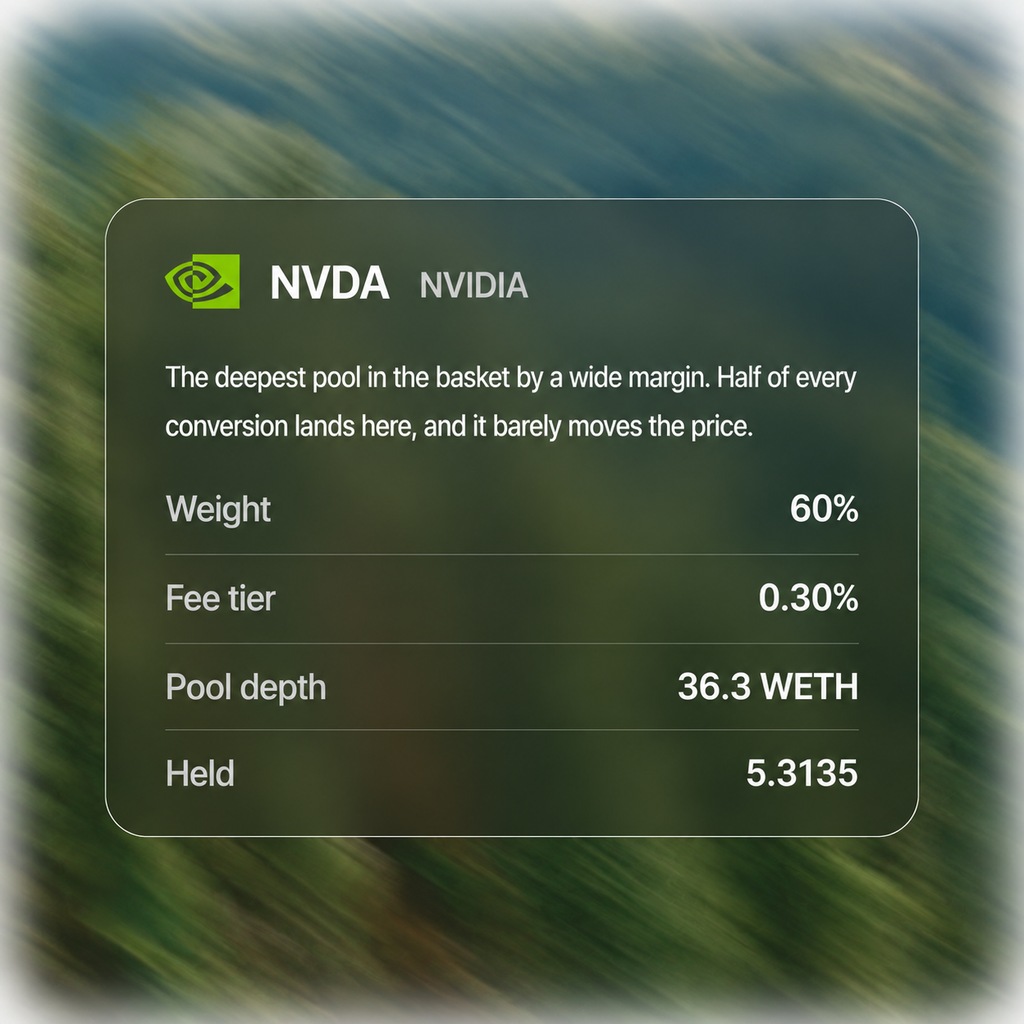
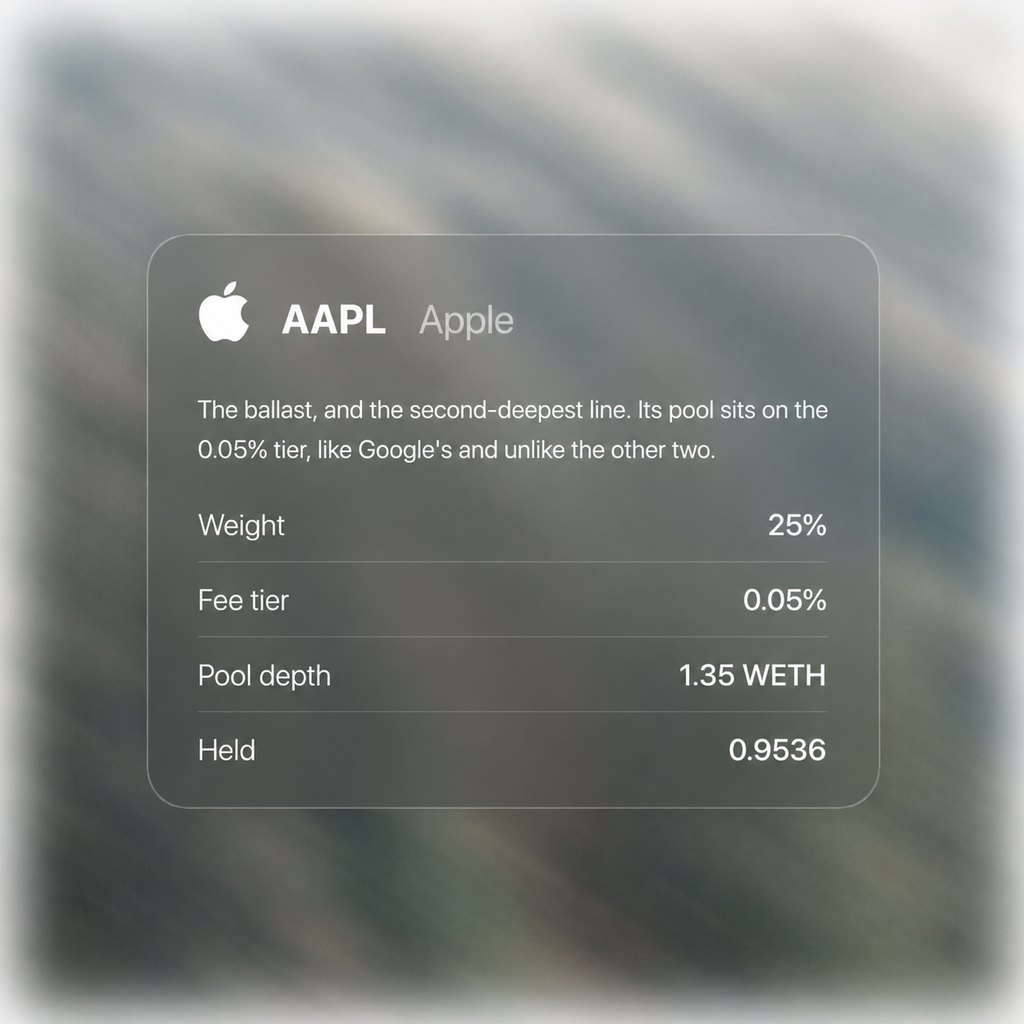
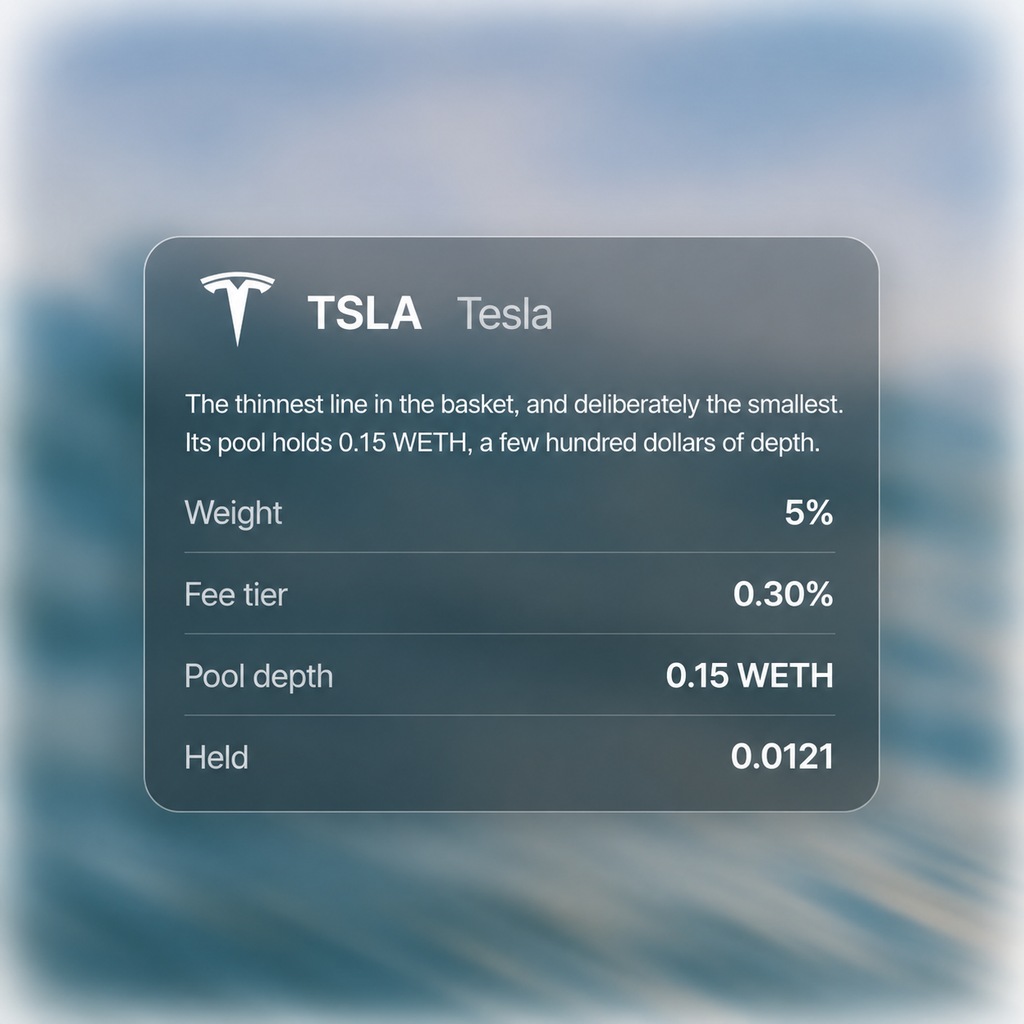
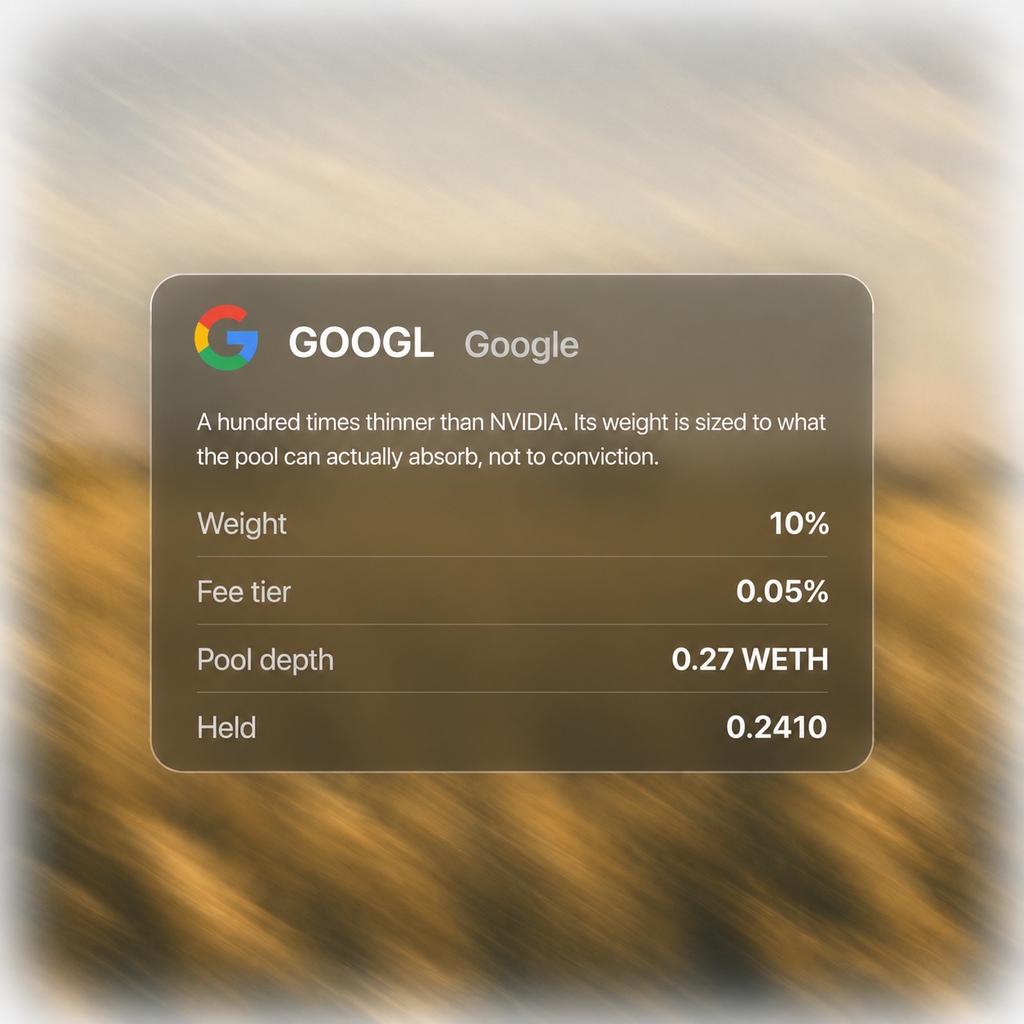
Weights are not opinions. Each one is the share its pool can absorb
without moving the price. Everything below was read from the chain on
25 August 2026. Depth moves; treat these as a snapshot, not a
constant.
| Asset | Weight | Bought via |
|---|
| NVIDIA | 15% | USDG |
| Apple | 15% | direct |
| Google | 10% | USDG |
| Tesla | 5% | USDG |
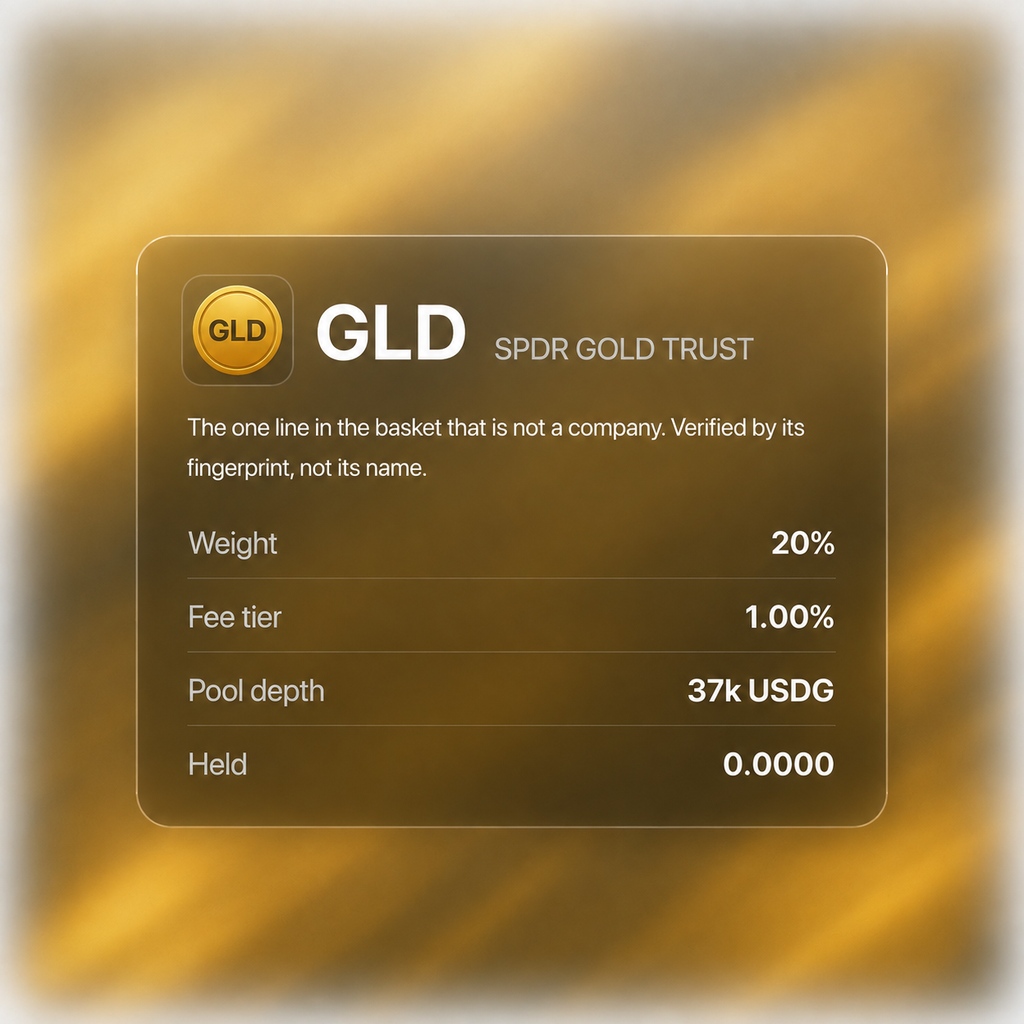
| Gold | 10% | USDG |
| S&P 500 | 10% | USDG |
| Strategy (MSTR) | 5% | USDG |
| Trump Media (DJT) | 10% | via USDG |
| Cash Cat | 10% | direct |
| Pons | 10% | direct |
The real market for these assets is USDG, not ETH. Every USDG
pool is ten to a hundred times deeper than its ETH counterpart, and Google has
no usable ETH pool at all — the pair exists but holds nothing.
Anyone telling you these "trade against WETH" has not looked.
The treasury used to buy with a single hop from WETH, which put
four of the five lines on the wrong venue. Measured on 19 August: routing NVIDIA
through USDG returns 0.53% more per conversion, Tesla
0.96% more. With NVIDIA then at 45% of the basket, buying head-on was
costing roughly 0.37% of every purchase, every hour. Seven of the ten lines route through USDG; the rest — Apple, Cash Cat and
Pons — buy direct, where their WETH pool is deep enough.
Apple is the exception and stays direct: through USDG it came out
0.06% worse. Every line is measured on its own, none of it is
assumed — which is the only reason the Apple result was found at all.
Selling uses the same principle from the other side. When you swap your claimed
assets back to ETH, the app quotes every live pool — direct and
through USDG — and routes down whichever pays more. The best path
depends on size, so it is quoted each time rather than hardcoded.
Three filters, and all three are hard
- Own fee tier. NVIDIA and Tesla sit on 0.30%, Apple on 0.05%,
gold on 1.00% — and NVIDIA has a second, shallower 0.05% pool that is sometimes the
better fill for small size. A single hardcoded tier routes half the basket into
pools that are not the best, and some into pools that do not exist.
- Quote token. USDG carries the depth, and reaching it costs a
second hop. Both sides now make that hop — the app when you sell, the treasury when
it buys.
- Two-sided depth. A pool holding only the asset lets you buy and
never sell. Handing redeemers something they cannot exit would be worse than leaving
it out.
Why gold, and how we know it is the real one
Gold is the one line in the basket that is not a company, which is the point: it
does not move with the same news as four tech stocks. It is
SPDR Gold Trust, the same tokenized-asset family as the equities.
This chain carries dozens of gold tokens with flattering names and vanity addresses.
A symbol proves nothing. The one in the basket was matched by
fingerprint: same deployer and byte-for-byte identical
contract code as the NVIDIA token. Its pool sits on the expensive 1.00%
tier, yet routed through USDG a 0.5 WETH purchase takes only
0.05% price impact — less than NVIDIA took buying head-on. A dear
tier on a deep pool beats a cheap tier on a thin one.
Verified on-chain
Every value below was read from the deployed contracts, not from documentation.
| Parameter | Value |
|---|
| Pool fee tier | 1.00% — forced, single config |
| Creator fee split | 70 / 30 |
| Share of volume captured | 0.350% |
| Token supply | 1,000,000,000 fixed |
| Launch market cap | 1.356 WETH |
| Graduation threshold | 4.2 ETH |
| Launch restrictions | 2 blocks only |
That last one matters: max wallet and max transaction apply for two blocks,
and only to buys from the canonical pool. After that the token behaves as a plain ERC-20.
Contracts
ChainRobinhood Chain · 4663
RPChttps://rpc.mainnet.chain.robinhood.com
PonsLaunchLocker0x736D76699C26D0d966744cAe304C000d471f7F35
PonsLaunchFactory0xA5aAb3F0c6EeadF30Ef1D3Eb997108E976351feB
SwapRouter020xCaf681a66D020601342297493863E78C959E5cb2
WETH0x0Bd7D308f8E1639FAb988df18A8011f41EAcAD73
FLOOR Vault0xEf9Cb10585F7641c89AFb5Ab97559749CB7B1b71
FLOOR Distributor0xc2f799fF3c16DBE4801A8bF9c9b47177BcFD2479
NVDA0xd0601CE157Db5bdC3162BbaC2a2C8aF5320D9EEC
AAPL0xaF3D76f1834A1d425780943C99Ea8A608f8a93f9
GOOGL0x2e0847E8910a9732eB3fb1bb4b70a580ADAD4FE3
TSLA0x322F0929c4625eD5bAd873c95208D54E1c003b2d
GLD0xC9a981FEE1F9DEc688bb123ccDeCc63D0deBFC4e
SPY0x117cc2133c37b721f49de2a7a74833232b3b4c0c
MSTR0xec262a75e413fafd0df80480274532c79d42da09
DJT0x1d11f0496982706c5e14a514d4e79f2e6bde4516
CASHCAT0x020bfC650A365f8BB26819deAAbF3E21291018b4
PONS0x39dbed3a2bd333467115de45665cc57f813c4571
Common questions
I bought on FOMO, GMGN, or another trading terminal — how do I claim?
Claiming is tied to the wallet address that holds your $FLR,
not the app you bought through. Our claim page connects any standard
wallet, so there is no terminal-specific button — and you do not need
one.
If your terminal wallet supports WalletConnect or has a built-in dApp browser:
open it, choose Connect → WalletConnect, and approve. On desktop you
scan the QR code; on mobile it deep-links straight back into your app.
Make sure the wallet is on Robinhood Chain, then claim as normal.
If your terminal does not connect to outside apps:
most of these terminals are self-custody and let you export your
private key or recovery phrase. Export it, import the wallet into
MetaMask or Rabby, add the Robinhood Chain network (the app will prompt
you), then connect here and claim.
The only hard requirement is that you control the wallet
holding your $FLR. If your tokens sit in a shared or custodial wallet
you do not control, move them to your own wallet first, then claim from
there. Your allocation does not expire while you sort this out —
unclaimed epochs are carried forward, so nothing is lost.
Where does my redemption arrive?
Directly in your wallet, as tokenized assets. You call redeem, you receive
NVDA, AAPL, GOOGL, TSLA, GLD, SPY and MSTR in one transaction, sized to your share of the
supply.
What if one equity is frozen when I redeem?
Your redemption is refused, and nothing is burned. Tokenized equities only
transfer while their market is open, and issuers keep a per-address restriction
list — so a line can be undeliverable through no fault of yours. Letting the
burn go through and silently dropping that line would destroy your tokens for a
partial basket, so the default is to refuse and let you retry later.
If a line is frozen for good, you are not trapped. A second, explicit button
redeems what can be delivered and gives up the rest. What you give up
does not leave the treasury — it stays as floor for everyone still holding.
We never take that door on your behalf.
Can one broken equity freeze the whole protocol?
No, and this took a rewrite to get right. An earlier version checked that every
equity was tradeable before allowing any redemption or any purchase. One equity
permanently frozen would then have locked redemptions and purchases for
everyone, forever — with no way back once ownership is renounced. Each line is now
isolated: a purchase that fails is skipped, a delivery that fails is refused on its
own, and the rest of the basket keeps working.
If there is a countdown, why do I still have to claim?
Because the countdown does not send you anything. When it hits zero a new
epoch opens, and everything the treasury is holding for holders —
including whatever nobody collected earlier — is split again across current
holders by time-weighted balance. You then collect whenever you want, and you keep
every token you hold.
Waiting costs you nothing. Only the latest epoch is payable at a time, so if you
skip a few, your share is not sitting in an old list going stale — it has been
folded back into the current one, and the number you see is larger. That is also
what keeps the books exact: what is promised is always what is actually there, so a
claim can never fail because someone else got there first.
The alternative would be pushing equities to every wallet automatically. That
needs the token to keep a list of its own holders on-chain, and a Pons token does
not have one. A push also caps out around 700 wallets per transaction, so past
that point a protocol has to start excluding small holders to keep going. Claiming
has none of those limits, and at the gas we measured here it costs about a cent.
How often does a new epoch open?
Every hour. The contract holds that number, not the keeper — it refuses
to publish before the interval has passed, so the cadence is verifiable rather
than promised.
An hourly epoch does not mean an hourly payout, and that distinction matters.
At $60k of daily volume the treasury captures about $210 a day, half of which goes
to holders. Split across six lines and a few hundred wallets, one hour is worth
a fraction of a cent each — far below the payout threshold.
Nothing is lost. Anything under the threshold is carried forward and paid as
soon as it is worth its gas. So a large holder is paid often, a small one
accumulates until the amount justifies the transaction, and neither has to wait
for a fixed weekly date. A slow cadence would make everyone wait for the slowest
case; the threshold handles it per wallet instead.
What stops the price falling below the floor?
Two things, and the second is unusual.
The first is the exit itself: if $FLR ever trades below what a token can
redeem, anyone can buy it cheap, burn it, and walk away with the difference. That
arbitrage closes the gap on its own.
The second is that the treasury does not wait for someone else to do it.
buybackAndBurn lets anyone make the treasury spend its
own WETH reserve to buy $FLR on the market and destroy it — but only at or
below a price ceiling held on-chain. Buying a token that redeems for more than it
costs, then burning it, mechanically raises the floor for everyone still holding.
It is open to anyone on purpose. The day the price dislocates is exactly the day
you do not want to depend on a bot being alive. And it cannot be abused: ask the
treasury to pay above the ceiling and the contract refuses; ask for more tokens than
the market will give and the trade fails. The only thing left to do with it is
trigger a buyback at a good price.
This second lever starts closed. The ceiling is zero until the
treasury sets one, and while it is zero the call simply reverts — there is no
floor to defend before the treasury holds anything. It gets armed once the basket is
worth defending, and the ceiling has to sit just under the real floor, which is why
it is a deliberate act rather than a launch default. The Overview panel shows the
live state: it reads burning x% of every fee for the automatic buyback, and
adds open at … WETH/token only once this one is armed.
The first defence — buy cheap, redeem, keep the difference — needs no
setting and works from the first block.
Do I need to stake or lock anything?
No. There is nothing to stake and nothing to lock. Claiming your equities costs
you no tokens at all — you keep everything you hold.
So how do I actually make money?
Two ways, and burning is not one of them. First, you claim your share of equities
every epoch while keeping all your tokens. Second, you sell higher — like any token.
Burning $200 of FLR the day you buy it returns only what the floor is worth, which
is a fraction of the price. The burn door is a safety net, not a payout.
How are my shares calculated?
Off-chain, on time-weighted balances over the epoch, and only the
Merkle root is published on-chain. Time-weighting is not optional: a plain snapshot
would be farmed by buying one block before it and selling right after. Claiming is a
single transaction with your proof.
Can the floor ever go down?
Not from anything a holder does — that is proven algebraically and verified by
fuzzing over hundreds of thousands of random operation sequences. It does pay a
small friction each time the treasury buys equities: measured at 28 basis points
per conversion at the 0.30% tier. Incoming fees exceed that by a wide margin.
Why these four and not others?
They are the ones that pass all three filters: a WETH pool, on a live fee tier,
with depth on both sides. SpaceX and Microsoft fail the last one —
their pools hold the equity and nothing to pay you back with. Amazon, AMD and
Palantir only exist against USDG. Oracle and CoreWeave have nothing at all.
Does splitting a redemption pay more?
Marginally. Because the floor rises with each redemption, exiting in ten pieces
returns about 97 basis points more than exiting at once. It is bounded, it costs gas
each time, and it never breaks the invariant.
What happens if nobody trades?
The treasury stops growing. The mechanism does not create attention — it rewards
it. What it guarantees is that whatever was accumulated stays accumulated: the floor
holds, it simply stops climbing.
Can protocol parameters change?
The owner can update the basket, its weights and the keeper. The exit fee can only
ever be lowered, never raised.
The basket will be frozen permanently once the weights settle — a one-way,
on-chain switch anyone can verify. We deliberately do not renounce
ownership on top of that. Renouncing looks like the stronger promise, but it also
destroys the ability to rotate a leaked keeper key and to remove an equity that
breaks. Those powers can only ever protect you. Freezing the basket removes the
one power that could not.
What is the worst case?
The Robinhood Stock contract exposes adminBurn, callable
with ADMIN_BURNER_ROLE, with no pause check and no blocklist check. The
issuer can destroy the equities held by the treasury. That risk is irreducible and
we would rather state it here than bury it.
Informational only; not financial, legal, tax, or investment advice. Distributions are
tokenized equities, not brokerage shares, and do not include voting rights or dividends.
Liquidity may be limited and prices can move materially.


 NVDA
NVDA AAPL
AAPL TSLA
TSLA GOOGL
GOOGL GLD
GLD SPY
SPY MSTR
MSTR INTC
INTC QQQ
QQQ CASHCAT
 / Floora /